
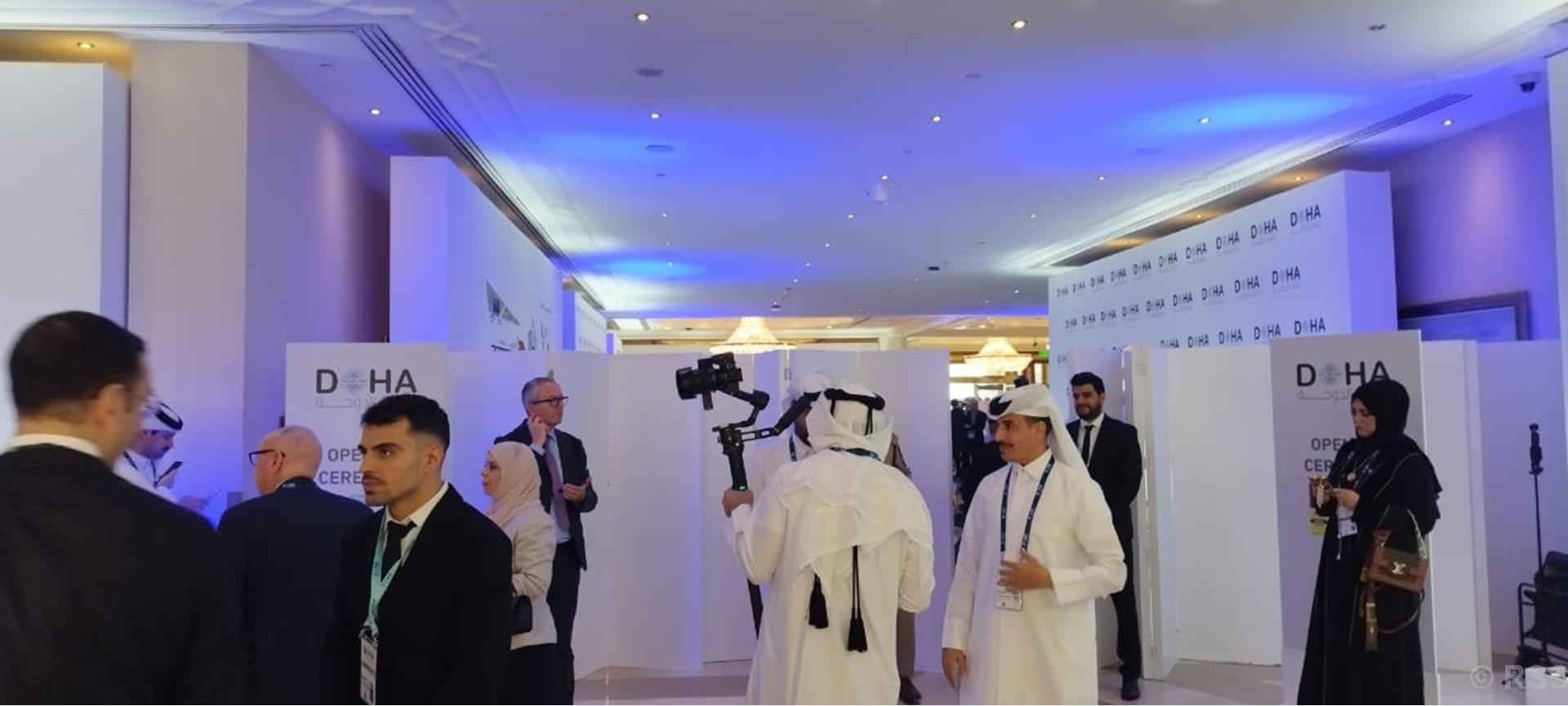
Doha (Qatar):The Doha Forum kicked off here on Saturday, with the delegates holding extensive discussions on global pressing challenges including world trade, technological development, and the transformative rise of artificial intelligence.
The two-day conference, organised with the aim of bringing together world leaders, policymakers, and global experts for a dynamic and solution-oriented dialogue, is believed to establish the platform as a timely centre for multilateral engagement against the backdrop of increasing geopolitical tensions and humanitarian needs.
The organisers have stated that the main topics included in the agenda include the Gaza crisis, global health financing, and the responsibility of relevant nations to raise funds for essential services.
Participants are expected to engage in intensive discussions at the meeting about the need to reconsider global trade routes amid changing national policies.
In a session held on Saturday, in-depth discussions were held on the direct and indirect impacts of AI and the US-China relationship. Although the US-China tariff dispute has affected trade and supply chains worldwide, it was expressed with satisfaction that recent agreements are reshaping global economic activity.
Dr Omar Khleif Al Gharaibeh, Associate Dean for Quality at the Business School of Al al-Bayt University in Jordan, told journalists in a forward-looking analysis about the forum’s agenda and its impact, “Amid global geopolitical turbulence, sluggish economic growth, and fluctuations among economically powerful nations, the ongoing International Doha Forum will prove to be a milestone in favour of balancing and strengthening the world economy, with a historic moment.”
Associate Dean of the Business School for Quality at Al Al Bayt University in Jordan, Dr Omar Khleif Al Gharaibeh, told journalists that the international Doha forum, taking place amidst global geopolitical instability, sluggish economic growth, and the ups and downs in trade ties among economically powerful nations, will prove to be a milestone with a historic moment in favour of balancing and strengthening the world economy.
He stated that ‘reimagining the future of business’ is no longer merely theoretical; it is a strategic necessity to recalibrate the global economic structure for flexibility and adaptability.
Al Gharaibeh described the emerging paradigm as flexible globalization, a departure from linear models, designed to navigate escalating risks.
He opined that yet this shift, while vital, faces real-world headwinds, including rising protectionism and the strategic weaponization of supply chains by global powers. These dynamics, he noted, render the reorganization of global trade more intricate than it appears on paper.
Associate Dean Al Gharaibeh explained that flexible globalization hinges on diversifying supply chains, reducing overreliance on limited production hubs, and selectively reshoring critical industries. It also calls for a regulatory overhaul that balances market openness with economic security.
However, these ambitions are challenged by intensifying tech wars and strategic rivalries, which hinder consensus on trade rules in sensitive sectors.
Al Gharaibeh emphasized that the forum’s theme, “Justice in Action: Beyond Promises to Progress,” aligns with the mission to recalibrate trade rules as a lever for global equity, not a mechanism for widening wealth gaps. This begins with empowering developing nations to access advanced markets, integrate into value chains through innovative financing, and boost digital readiness.
Deliberations on conflict resolution and sustainable peace building
Another debate held on Saturday in collaboration of the major Think Tank and global organisations discussed the responsibility of regional and global actors in international economic crisis, conflict resolution and sustainable peace building.
Discussion was also held about relations between Gulf countries and European Union in the session co-organised by International Policy Research Centre, Konrad Adenauer Foundation and Gulf Research Centre. It would assess changing geopolitical dynamics and opportunities for renewed cooperation.
The Forum with partnership of the Gates Foundation would address the instability of global health financing, it is said. Discussion was held about new ways to strengthen primary health service systems when declining international assistance could put the achieved progress at risk.
A session with ‘Centre for China and Globalization’ focused on the study and effects of the evolving US-China relations including an assessment for trade, diplomacy, and re-establishment of power in the changing world context.
More than 6,000 participants and around 500 speakers of more than 160 countries in the world have made Doha Forum more effective and prestigious. The Forum as a global dialogue platform has tried to link diplomacy with partnership forwarding cooperation, accountability and shared progress.
In inaugural ceremony, Prime Minister of Qatar Sheikh Mohammed bin Abdulrahman Al Thani said, “The role of Qatar in the global forum is focused to maintaining dialogue and mediation. We will help to resolve conflict and end human sufferings without favouring any side.”
He opined that Qatar played an active role at the initiative for the establishment of peace in Gaza and Ukraine.
In Doha Forum, world-renowned industrialist and founder of Microsoft Bill Gates pointed out the need of financial support and use of technology to strengthen global health system.
“We should take collective initiative to tackle health challenges in future and attention should be paid in system-wise reform,” he viewed.
Qatar’s Al-Raya daily has emphasized the significance of the Doha Forum 2025, stating that this event is crucial given the current delicate global landscape. “The forum will aid in steering the world towards a just path amidst political strife, humanitarian emergencies, and swift technological advancements,” the daily notes.
The Doha Forum has positioned Qatar not just as a host but as an active contributor to shaping the future of the globe. Various sessions at the forum have focused on critical topics such as mediation, the Gaza crisis, funding for global health, strategies for artificial intelligence, and relations among major powers.
Participants have indicated that these discussions have delivered a vital message: practical solutions are essential for constructing a sustainable, equitable, and balanced world. Al-Raya reported that the Doha Forum 2025 reaffirmed Qatar’s robust dedication to multilateral diplomacy and bolstered the dialogue and cooperation necessary to tackle significant global challenges.
Power of Media and the Search for Truth discussed
In another noteworthy discussion programme titled ‘The Power of Media and the Search for Truth,’ held in partnership with international media, there was significant involvement from senior journalists from various nations worldwide.
The panel discussion, led by Sky News journalist Yalda Hakim, included thorough discussions on urgent global matters and potential solutions. The programme, co-organized by Neil Patel, executive director and co-founder of the American political debate programme Tucker Carlson Network, saw participants commend the resilience and bravery of journalists engaged in on-the-ground reporting in the Gaza area.
They underscored the increasing significance of new media in contemporary journalism, predominantly accessed via smart devices and mobile phones, particularly on social media platforms. This shift has transformed how news and information are shared in today’s world, necessitating that mass communicators become proficient in these tools as technology evolves.
The speakers emphasized the critical role of these platforms in enhancing and speeding up the distribution of news content generated by traditional media outlets, such as newspapers, radio stations, news agencies, and television networks. They also addressed some of the drawbacks associated with certain modern media tools during their discussion.
The programme specifically pointed out the role of AI technologies in the rapid spread of unverified information or the creation of false or misleading content.
At the conclusion of the event, the panelists called for a cautious approach to media that disseminates deceptive or fabricated news without credible sources. They advocated for a focus on creative and meaningful journalism that contributes to societal development and progress through effective communication, while also urging the responsible use of AI to foster more refined and responsible journalism.-Dharmendra Jha/RSS

Happy

Sad

Wonderful

Excited

Angry