

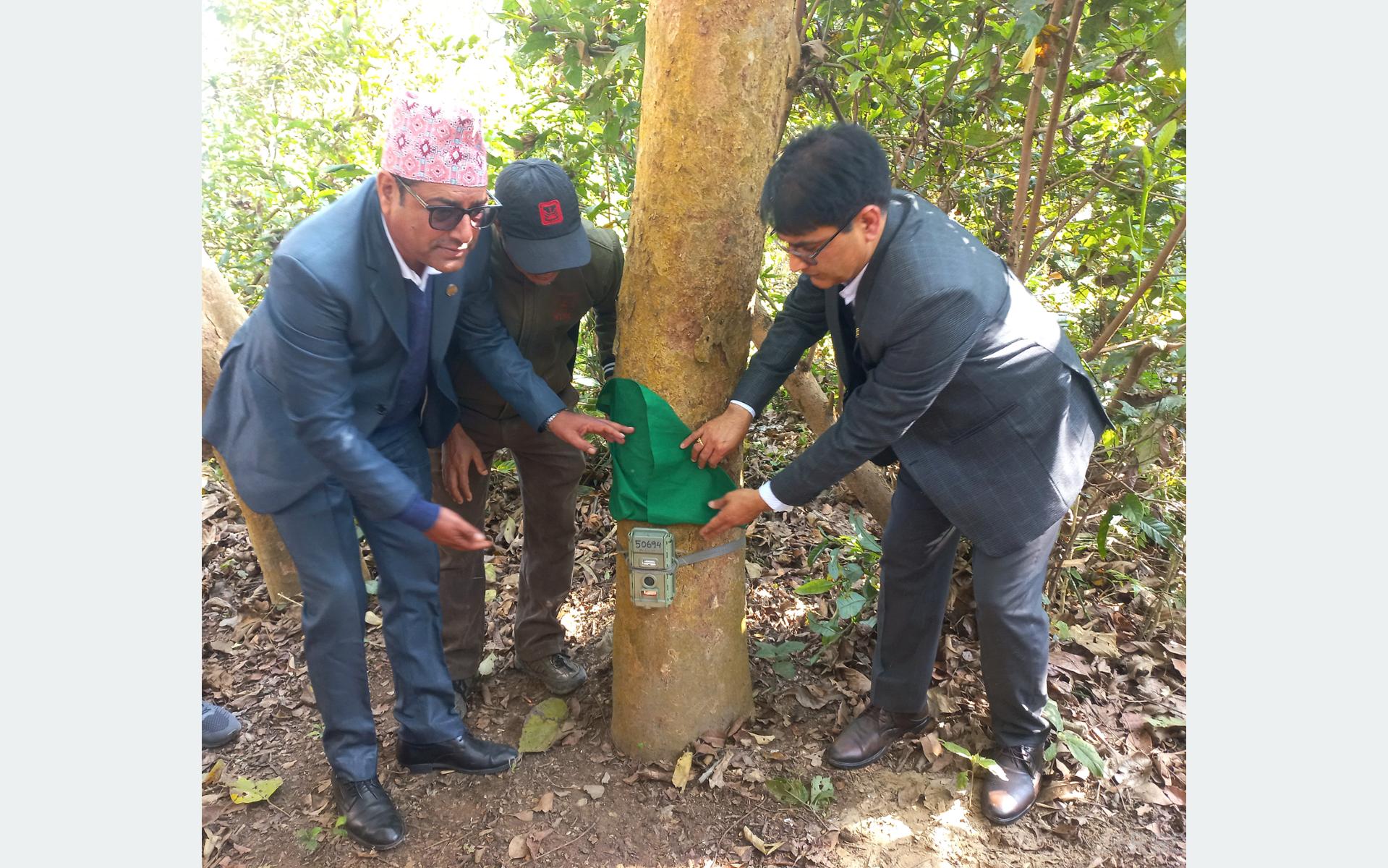
Chitwan: Nationwide tiger census, conducted once every four years, officially commenced today. The launch was marked by a formal inaugural programme held in Sauraha, Chitwan.
The census is being led by the Department of National Parks and Wildlife Conservation (DNPWC) under the Ministry of Forests and Environment, in coordination with the Department of Forests and Land Conservation. The National Trust for Nature Conservation (NTNC), World Wide Fund for Nature (WWF) Nepal, and the Geological Society of Nepal are providing technical and logistical support.
The tiger count is being carried out with the assistance of the Nepali Army, Buffer Zone and Community Forest Users’ Committees, it is said. According to the DNPWC, the census is expected to be completed within two and a half to three months, with the nationwide mobilisation of 25 technical personnel.
DNPWC Director General Buddi Sagar Paudel stated that 1,100 advanced camera traps are being installed across tiger habitats. The tiger population will be estimated through the analysis of photographic captures of the species.
An estimated budget of approximately Rs 30 million is expected to cost for the census, covering the mobilisation of human resources, management of memory cards, tents, sleeping bags, and other logistical requirements.
The camera traps being used for the census were procured earlier, with each purchased at an around Rs 35,000.
Nepal has started counting the tiger population systematically using automated camera trap since 2009.
In 2009, there were 121 tigers in Nepal. Counting of tiger is being carried out in every four years since 2009. As per the Tiger Conservation Action Plan, the tiger census was already conducted in 2013, 2018 and 2022. Now, the counting of tigers is being conducted for 2026.
Nepal has started observing the Tiger Day since 2067 BS and counting of tiger population is carried out nation-wide in every four year.
The population of tiger was 98 in 1995, one hundred and nine in 2000, one hundred and twenty-six in 2005, one hundred and twenty-one in 2009, one hundred and ninety-eight in 2013 and 235 in 2018.
For reducing the human-tiger conflict, he suggested providing alternative means of livelihood to the communities living on the fringes of the forests so that they will not have to go into the forests for livelihood and to change the attitude and behavior of the locals towards the wildlife.
18 problematic tigers caged throughout the country
The issue of problematic tigers is also rising in national parks, conservation areas and surrounding regions with a significant increase in the number of tigers. In particular, tigers that have entered human settlements, attacked humans and domestic animals, or have been found injured are being rescued and kept in enclosures.
Currently, there are 18 troublesome tigers across the country. Among them, five are kept in cages at the central zoo in Jawalakhel, Lalitpur, seven in Chitwan National Park, four in Bardia National Park, and one each in Banke and Parsa National Parks. The government has been spending a large amount annually on the daily feeding, care, treatment, and other management of such tigers.
According to the latest figures in 2025, the number of tigers in the world has increased to 5,357. Among them, the highest number is in India with 3,167, followed by Russia with 750, Indonesia with 400, Nepal with 355, Thailand with 189, Bhutan with 151, Malaysia with 150, Bangladesh with 146, Myanmar with 22, China with 20, Vietnam with five, and Laos with two tigers. (Bhishma Raj Ojha/RSS)

Happy

Sad

Wonderful

Excited

Angry